Choose timezone
Your profile timezone:
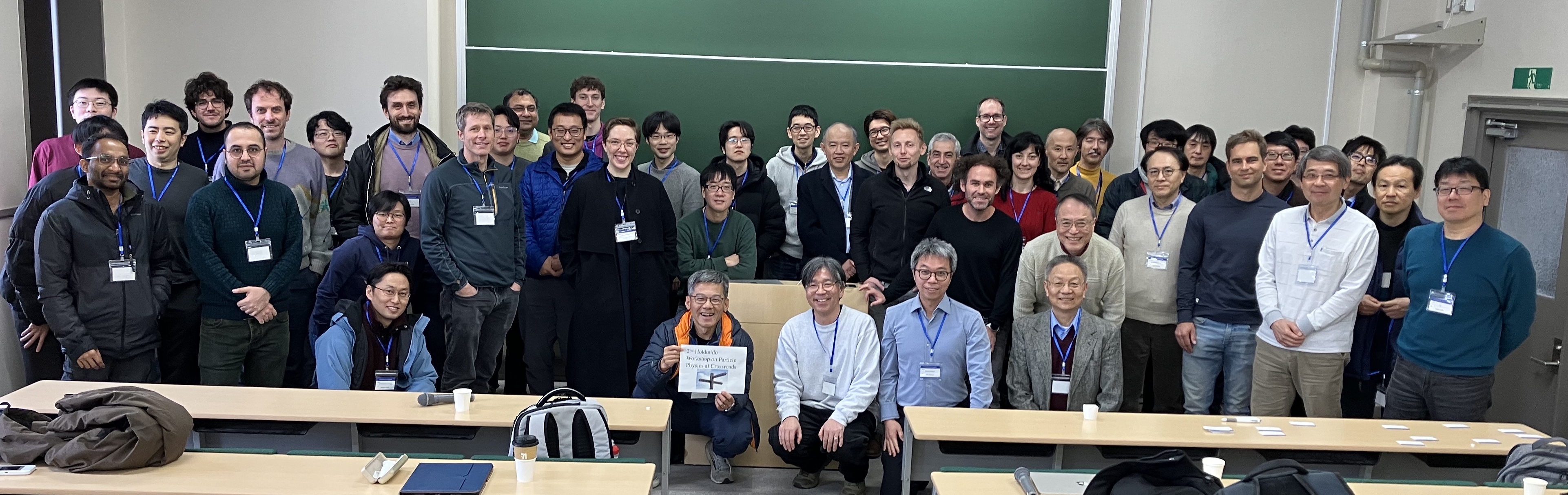
Particle physics is at crossroads: the Standard Model is confirmed with unprecedented precision after decades of experimental explorations, and yet it offers no explanation to some of the most profound scientific puzzles such as the nature of dark matter and dark energy. Moreover, past theoretical guiding principles such as naturalness have not bore fruit in experimental searches. Quo vadis particle physics?
Pondering on the future, we would like to gather a small group of theoretical and experimental experts in an informal setting to evaluate the current state of affairs and devise future strategies, all surrounded by the natural beauty of Hokkaido in the winter.
This is the 2nd workshop of this series.
(last one in 2024: https://conference-indico.kek.jp/event/248/)
Invited Speakers:
So Chigusa (MIT)
Takeo Moroi (U. Tokyo)
Shinya Kanemura (Osaka U.)
Federico Meloni (DESY)
Enrique Rico Ortega (CERN)
LianTao Wang (U. Chicago)
Josh Ruderman (NYU)
Gilad Perez (Weizmann)
Hooman Davoudiasl (BNL)
Jianwei Qiu (JLab)
Paddy Fox (Fermilab)
Stefania Gori (UC Santa Cruz)
Martin White (Adelaide)
Shih-Chieh Hsu (U. Washington)
Tova Holmes (U. Tennessee)
Yuta Hamada (KEK)
Toshifumi Noumi (U. Tokyo)
Tom Melia (IPMU)
Gurucharan Mohanta (APCTP)
Audrey Fung (APCTP)
Seung Joon Lee (KIAS)
Masahiro Ibe (ICRR)
Sungwoo Hong (KAIST)
Misao Sasaki (IPMU/APCTP)
Hyun Min Lee (Chung-Ang U.)
Satoshi Shirai (IPMU)
Keisuke Harigaya (U. Chicago)
Zhen Liu (U. Minnesota)
Ken Van Tilburg (NYU)
Masashi Otani (KEK)
Taikan Suehara (U. Tokyo)
random order
Organizers:
Kento Asai (YITP, Kyoto U.)
Arindam Das (Hokkaido U.)
Shusei Kamioka (KEK)
Ryuichiro Kitano (YITP, Kyoto U.)
Ian Low (Northwestern U./ANL)
Ryutaro Matsudo (YITP, Kyoto U.)
Tsutomu Mibe (KEK)
Shinji Ogawa (KEK)
Shohei Okawa (APCTP)
Osamu Seto (Hokkaido U.)
Sponsors:
KEK, YITP, APCTP
This workshop is supported by the JSPS KAKENHI grants, "Promotion of muon particle physics in an international framework," JP22K21350 and the U.S.-Japan Science and Technology Cooperation Program in High Energy Physics. The workshop is also supported by the Yukawa Institute for Theoretical Physics at Kyoto University (YITP-X-25-06) and Asia Pacific Center for Theoretical Physics (APCTP-2026-E02).


Muons offer a unique opportunity to build a compact high-energy electroweak collider at the 10 TeV scale. A high-energy muon collider is
the natural next step in the exploration of fundamental physics after the HL-LHC and a natural complement to a future low-energy Higgs factory.
As an invited speaker I'd love to talk about any of these topics:
- muon collider overview
- the muon collider technological R&D programme
- experimentation at muon collider (with a focus on the MAIA detector concept)
- the physics potential (SM and/or BSM)
A Muon Synchrotron Ion Collider (MuSIC) can provide a path beyond the Electron Ion Collider at Brookhaven National Laboratory, and be part of a research and development effort towards future multi-TeV muon beams. In this talk, we illustrate that, besides being a powerful tool for studying nuclear physics and Standard Model processes, MuSIC can also have significant reach for new physics across a broad range of energy scales.
Owing to the color confinement, phenomena of strong interaction physics could be described either in terms of fundamental quarks and gluons of Quantum Chromodynamics (QCD) or as mesons and baryons and the nuclear force between them, depending on the momentum/distance scales at which the phenomena are probed, while mesons and baryons themselves are confined dynamic systems of quarks and gluons. Understanding fully the relationship between this dual representation of strong interaction physics requires us to explore the inner structure of nucleons and nuclei and its emergence from QCD dynamics. In this talk, I will review the physics goals of the EIC, currently under the construction at Brookhaven National Laboratory. I will demonstrate that both theory and experimental technology have now reached to a point where we can explore the inner structure of nucleons and nuclei at sub-femtometer distance scales and their underline dynamics with controllable precision, allowing us to search for answers to the most compelling and fundamental emergent phenomena of the strong interaction physics, as well as the quantum nature of these phenomena. I will also discuss the challenges and opportunities presented by the EIC.
In high energy physics, most machine learning models are still built for narrow, task-specific analyses, which makes it hard to scale across the immense space of new physics possibilities. In this talk, I’ll introduce EveNet, a foundation model we developed to change that paradigm.
EveNet is a transformer trained on 500 million simulated Standard Model events, combining self-supervised and supervised objectives to learn a common event representation. With just light fine-tuning, it handles very different analysis tasks effectively. Tested on CMS Open Data, it matches—and often outperforms—models trained specifically for those individual tasks. Even more interestingly, EveNet generalizes well to beyond-Standard-Model signals and real collision data, suggesting it’s learning the underlying physical structure of the events themselves.
I’ll discuss what this means for the future of collider studies—how a single pretrained network might streamline hundreds of analyses and move us closer to a genuinely universal, data-driven approach to event understanding.
The development of TeV-class compact accelerators requires ultra-high electric fields, ultra-high magnetic fields, and ultra-high beam focusing technologies. Furthermore, energy recovery technology is also crucial, and the development of accelerators incorporating all these features is highly desired.
Particularly for decaying particles like muons, it is desirable to accelerate them as quickly as possible and recover their energy as rapidly as possible.
I would like to introduce our examination of concepts that enable these capabilities.
We investigate TeV scale seesaw scenarios at $\mu^+ e^-$ and $\mu^+ \mu^+$ colliders in the $\mu$TRISTAN experiment. In minimal type-I seesaw scenario we consider two generations of Standard Model (SM) singlet heavy Majorana type Right Handed Neutrinos (RHNs) which couples with SM gauge bosons through light-heavy neutrino mixing. \bl{We discuss the prospects of probing heavy neutrinos via the processes such as $\mu^+e^-\to \nu N_i\to e^+ j j\nu$ or $\mu^- j j\nu$ for $\sqrt{s}=346$~GeV and $1\text{ ab}^{-1}$ luminosity. Studying these process, we estimate limits on the light-heavy neutrino mixing angles as a function of heavy neutrino mass, which could be two orders of magnitude stronger than electroweak precision data.} Further, we study the effect of doubly charged scalar boson $(H^{++})$ from the type-II seesaw scenario in $\mu^+ \mu^+$ collision at $\sqrt{s}=2$ TeV. In this case we consider $\mu^+ \mu^+ \to \ell_i^+ \ell_j^+$ and $\mu^+ \mu^+ \to H^{++} Z/ \gamma$ processes followed by the same sign dilepton decay of $H^{++}$. We find that events involving $e^+ e^+$ among these final states can probe the neutrino mass ordering in $\mu$TRISTAN experiment at 5$\sigma$ significance. In addition to that we study the production of positively charged triplet fermion in $\mu$TRISTAN following $\mu^+ \mu^+ \to \mu^+ \Sigma^+$ process where $\Sigma^+$ decays into $\mu^+ jj$ mode through $Z$ boson exchange. Considering a triplet at 1 TeV and studying SM backgrounds we estimate the discovery potential of $\mu^+ \mu^+ jj$ signal at $\mu$TRISTAN with respect to projected luminosity.
We consider an extension of the Minimal Standard Model with the seesaw mechanism by two right-handed neutrinos in order to account for the neutrino mass consistent with oscillation experiments.
In particlar, we discuss the case in which they have TeV-scale masses, since it may be possible to probe them at future colliders.
A key prediction of the seesaw mechanism is that neutrinos are Majorana particles, which naturally lead to lepton number violation (LNV).
In this presentation, we investigate the processes $l^\pm l^\pm \to W^\pm W^\pm (l = e,\mu)$, violating the lepton number by two units.
The electron channel is induced at the fourth order of the mixing elements of electron, and then is strongly suppressed by neutrinoless double beta ($0\nu2\beta$) decay.
% This is because the neutrinoless double beta decay gives a strong constraint.
In contrast, for the muon channel, one might think that a much larger cross section is possible being free from the above constraint.
However, in the seesaw model, the mixing elements of electron and muon are not completely independent.
We show that only in the normal hierarchy (NH) the hierarchy of mixing elements can be realized leading to the sizable cross section.
In addition, not only the constraint from $0\nu2\beta$ decay, but also that from electroweak precision measurements become important for large Majorana mass region.
As a consequence, future muon colliders such as $\mu$TRISTAN are possible to probe LNV signatures of TeV-scale seesaw model if neutrino is the NH.
Vector boson scattering (VBS) provides a direct window into the dynamics of electroweak symmetry breaking. In the Standard Model, the observed Higgs boson unitarizes the scattering of longitudinally polarized weak gauge bosons, keeping VBS cross sections under control even at high energies. If, however, the Higgs couplings deviate from their Standard Model values, the scattering amplitude grows with energy, indicating the presence of additional dynamics beyond the Higgs sector.
In this talk, I discuss the potential of the future $\mu^+\mu^+$ collider $\mu$TRISTAN to probe such deviations through measurements of longitudinal VBS at multi-TeV energies. I show that the clean environment and high energy reach of muon colliders enable precise tests of the unitarization mechanism of VBS. These measurements provide a stringent criterion for assessing whether the observed Higgs boson alone is responsible for electroweak symmetry breaking, or whether new interactions are at work.
We study Top-Yukawa sensitivity of various processes at muon collider.
We quantify the discovery potential of future multi-TeV plasma wakefield colliders for new electroweak multiplets. We include beam-beam effects through realistic luminosity spectra, comparing five collider configurations: e+e− and e−e− machines with round- and flat-beams, and a γγ collider. The beam-beam effects qualitatively change search strategies relative to idealized mono-energetic lepton colliders, highlighting the importance of the low-energy part of the luminosity spectrum and additional beam-induced initial-state channels. Our results have implications for accelerator R&D priorities, since key electroweak targets may remain accessible even if efficient positron acceleration and flat-beam delivery prove technically challenging at the multi-TeV scale.
The observed hierarchies in fermion masses and mixing angles in the Standard Model, the so-called flavor puzzle, strongly suggest the presence of a new flavor structure or symmetry at high energies. At the same time, searches for nucleon decay provide one of the most powerful experimental probes of ultra-high-energy physics. Because both nucleon decay and flavor symmetries govern interactions among matter fermions, their effects are deeply interconnected: flavor structures can shape nucleon decay rates and branching patterns, while current and future experimental observations of nucleon decay can, in turn, offer significant insights into flavor models. In this talk, I will explore this relationship, highlighting how flavor symmetries can manifest in nucleon-decay signatures and how upcoming searches may reveal the underlying flavor structure of nature.
We propose the simple extensions of the Standard Model with an extra global or local abelian symmetries for the origin of masses for neutrino and charged leptons. First, we explain small neutrino masses with a Z4 symmetry by the radiative seesaw mechanism with inert doublet Higgs, right-handed neutrinos and extra singlet scalars transforming nontrivially under the Z4. In this model, we discuss the implications of the Z4 symmetry for thermal leptogenesis and direct detection/collider experiments. Moreover, we consider a tree-level seesaw mechanism for generating charged lepton masses in models with vector-like leptons and an extra local SU(2) symmetry, and discuss the constraints on the model coming from the lepton g-2 and lepton flavor violation. In this case, the dark isospin-charged gauge bosons of the extra SU(2) become dark matter candidates with almost the same masses as the dark isospin-neutral gauge boson, which are correlated with electroweak precision measurements such as the W boson mass and the lepton Weinberg angle.
We consider weakly interacting massive particle (WIMP) dark matter in a Parity solution to the strong CP problem. The WIMP phenomenology can be drastically affected by the presence of Parity partners of the WIMP and electroweak gauge bosons. We focus on a Parity extension of SU(2)L-doublet fermion dark matter, identify the viable parameter space, and derive the predictions of the theory. We find that the Parity symmetry breaking scale is bounded from above, with the bound given by 25−60 TeV, depending on whether or not dark matter and its Parity partner coannihilate with each other. The High-Luminosity Large Hadron Collider, future colliders, and direct and indirect detection experiments can probe the parameter space further, with correlated signal rates.
We propose simple scenarios in which the observed dark matter abundance arises from the decays and scatterings of heavy quarks via the freeze-in production of an axion-like particle with mass in the 10 keV–1 MeV range. These models can be tested by future X-ray telescopes, and in some cases will be almost entirely probed by searches for the two-body decay K→π+invis at NA62. As a byproduct, we discuss the cancellation of IR divergences in flavor-violating scattering processes relevant for thermal axion production, and we derive the general contribution to axion–photon couplings from all three light quarks.
Big Bang Nucleosynthesis (BBN) is a powerful and unique probe of new particles. In particular, if hadrons are injected by a new particle during BBN, the measurement of helium-4 can constrain the lifetime of that particle to be significantly shorter than the BBN time scale. In this talk, I will discuss new developments that include previously missing effects, such as scattering processes involving KL and secondary hadrons. I will then apply these results to the heavy QCD axion and obtain the first robust BBN bounds. This talk is based on arXiv:2510.23695.
We demonstrate that the observed baryon asymmetry in the Universe can be accommodated in the extended Standard Model with sequential fourth generation fermions (SM4). We first construct the dimension-6 effective operators $(\Phi^\dagger\Phi)\bar U_L\Phi D_R$ induced by fourth-generation heavy quarks, which carry the $CP$ violation (CPV) source from the $4\times 4$ Cabibbo-Kobayashi-Maskawa (CKM) matrix, $\Phi$ ($U$, $D$) being a Higgs double (up-type fermion, down-type fermion). The required inputs of the fourth generation fermion masses were derived in our earlier dispersive analyses on heavy quark decays and neutral quark state mixing through box diagrams. The similar analysis allows the determination of the $4\times 4$ CKM matrix elements $V_{ib'}$, $i=u$, $c$ and $t$, such that the strength of the CPV source for $f=\tau'$ and $\nu'$, i.e., fourth generation charged leptons and neutrino, respectively, can be fixed unambiguously. The dimension-6 operators for fourth generation leptons, as implemented into the formalism for the electroweak baryogenesis in the literature, lead to the baryon-over-entropy ratio $\eta_B\approx 10^{-10}$. As last, we discuss the potential for searching for fourth generation fermions at the LHC.
Grand Unified Theories (GUTs) aim to unify the gauge groups of the Standard Model into a single symmetry at high energies. However, in the minimal SU(5) model, the predicted proton lifetime is significantly shorter than the current experimental lower bound, and the gauge couplings do not precisely converge at a single point. In this study, we address these issues by introducing multiple heavy fermions in the 5 and 10 representations, in addition to the usual three chiral generations. Our analysis shows that with a sufficient number of such fermions, the gauge coupling constants achieve exact unification at a single scale, while proton decay is adequately suppressed to satisfy experimental constraints.
We discuss two Higgs doublet models with successful electroweak baryogenesis but without cancellations of electric dipole moments (EDMs). For the baryogenesis, additional scalar bosons are favored to couple mainly with the top quark with CP violations. However, if they also couple to light fermions of the Standard Model, the model is limited severely by EDMs, and additional CP phases irrelevant to the baryogenesis are often introduced to cancel the contributions to the EDMs. We here discuss a scenario where the light-fermion couplings are suppressed to avoid the constraints. We show that our scenario is compatible with the current experimental bounds and is within the scope of future EDM experiments.
I will summarise recent work from the Adelaide group on quantum information topics relevant to high energy physics. This includes the measurement of quantum information-inspired concepts at colliders (such as non-stabiliserness) that may give us new ways to search for BSM physics. It also includes work that suggests that some symmetries of the Standard Model and its extensions may result from the imposition of specific patterns of quantum correlations in the final state of scattering processes.
Understanding the confinement mechanism in gauge theories and the universality of effective string-like descriptions of gauge flux tubes remains a fundamental challenge in modern physics. We probe string modes of motion with dynamical matter using a digital quantum simulation of a (2+1) dimensional gauge theory on a superconducting quantum processor with up to 144 qubits, stretching the hardware capabilities with quantum-circuit depths comprising up to 192 two-qubit layers. We realize the $Z_2$-Higgs model ($Z_2$HM) through an optimized embedding into a heavy-hex superconducting qubit architecture, directly mapping matter and gauge fields to vertex and link superconducting qubits, respectively. Using the structure of local gauge symmetries, we implement a comprehensive suite of error suppression, mitigation, and correction strategies to enable real-time observation and manipulation of electric strings connecting dynamical charges. Our results resolve a dynamical hierarchy of longitudinal oscillations and transverse bending at the endpoints of the string, which are precursors to hadronization and rotational spectra of mesons. We further explore multi-string processes, observing the fragmentation and recombination of strings. The experimental design supports 300,000 measurement shots per circuit, totaling 600,000 shots per time step, enabling high-fidelity statistics. We employ extensive tensor network simulations using the basis update and Galerkin method to predict large-scale real-time dynamics and validate our error-aware protocols. This work establishes a milestone for probing non-perturbative gauge dynamics via superconducting quantum simulation and elucidates the real-time behavior of confining strings.
In this talk, I will introduce the notion of global aspects in the physics of particles and topological defects. A well-known example is the global structure ambiguity of the Standard Model (SM) gauge group. I will discuss the correlation between the quantization conditions of axion–gauge couplings and this global structure, and its implications on axion domain wall physics.
As another example, I will describe how various global structures play important roles in the domain wall problem of the DFSZ axion model. A precise identification of the axion string–domain wall network—and hence the true nature of the domain wall problem—becomes possible by recognizing a discrete overlap between the Peccei-Quinn symmetry and the SM gauge group.
An elegant solution to the domain wall problem can also be realized by introducing another global structure shared between the color and family gauge groups, which gives rise to discrete non-invertible Peccei-Quinn symmetries. This discrete non-invertible symmetry can then be slightly broken by small instanton effects in a UV completion in the form of an SU(9) color–flavor unification.
If time permits, I will also discuss group-theoretic methods for analyzing topological sectors and global structures in Grand Unified Theories, and homotopy group and their exact sequence analysis for non-topological as well as topological defects.
We analyze the connection between the Nambu-Goldstone theorem and the Quantum Yang Baxter Equations (QYBE), demonstrating in this way that the problem of counting and dispersion relation disappears when we impose constraints coming from the QYBE inside the dynamics of the Nambu-Goldstone bosons. Subsequently, we show that the the Hawking radiation is a mechanism of spontaneous symmetry breaking where the order parameter comes out to be the particle number operator, which vanishes before the formation of the Black Hole and is different from zero after its formation. From this perspective we then analyze some interesting aspects about the Black Hole evaporation process.
Finally, we extend the symmetry arguments in order to explore the neutrino mass problem, finding then certain constraints between the mixing angles as well as between the mass eigenvalues. The analysis suggests a normal ordering and the predicted values are inside the experimental observation ranges.
In this talk, I will introduce the intriguing interplay between cosmology and strongly coupled dynamics, showing how temporary spectral features can leave lasting, observable imprints on the primordial fluctuation spectrum. Focusing on nearly conformal extensions of the Standard Model and employing AdS/CFT reasoning, I will demonstrate the emergence of gapped structures and distinct particle-like peaks in the scalar operator's spectral density within an inflationary setting. I will then estimate their contribution to cosmological observables, emphasizing unique, potentially detectable phenomena for future experiments, such as displaced oscillations in the squeezed bi-spectrum, originating from both fundamental and composite particles, and briefly touch upon the link between conformal symmetry breaking stabilization and these spectral signatures. I will also discuss composite inflaton from AdS/CFT construction.
Instantons play a central role in the semiclassical description of non-perturbative phenomena in gauge theories. Their interpretation, however, can be subtle in the presence of spontaneous symmetry breaking or when topological information is treated in a nontrivial way.
In this talk, we revisit conceptual issues surrounding instantons, focusing on how semiclassical configurations and their contributions should be defined and interpreted beyond naive instanton counting. In particular, we discuss the roles of constraints and controlled limiting procedures, and clarify what must be specified to make well-defined semiclassical analyses. This includes both the construction of the relevant minimum configurations and the prescription for evaluating and combining their contributions. Where useful, we draw on simpler settings and lower-dimensional analog models to illuminate the underlying mechanisms.
Over the past two to three decades neutrino oscillation experiments have shown that neutrinos are massive and mix significantly. This can be described largely model-independently using the dimension-five Weinberg operator, giving rise to Majorana neutrino masses after electro-weak symmetry breaking. Its renormalization and running effects have also been increasingly considered. It was found that the rank of the mass matrix cannot be increased at the one-loop level, while two-loop running effects can raise the rank via Yukawa interactions. However, effects from flavor-dependent gauge interactions have not been taken into account until now. We show that in such theories, the rank of the mass matrix can be increased already at the one-loop level, generating non-zero neutrino masses via RGE running, presenting the only possibility to do so. We elucidate this mechanism using the example of a U(1){Lmu - Ltau} gauge extension with an anarchical structure of the mass matrix, and a possible ultraviolet completion with right-handed neutrinos in a Type-I Seesaw model.